African forest elephants and African savanna elephants are not simply the same animal living in two different habitats. They are separate species with deep evolutionary divergence, different body proportions, different ecological roles and different conservation challenges.
The confusion persists because both were once grouped under a single African elephant species. Modern genetics has changed that picture.
Two species, not just two habitats
The African savanna elephant is Loxodonta africana. The African forest elephant is Loxodonta cyclotis.
Genetic studies have shown deep separation between the two lineages, strong enough to support treatment as distinct species.
Body size
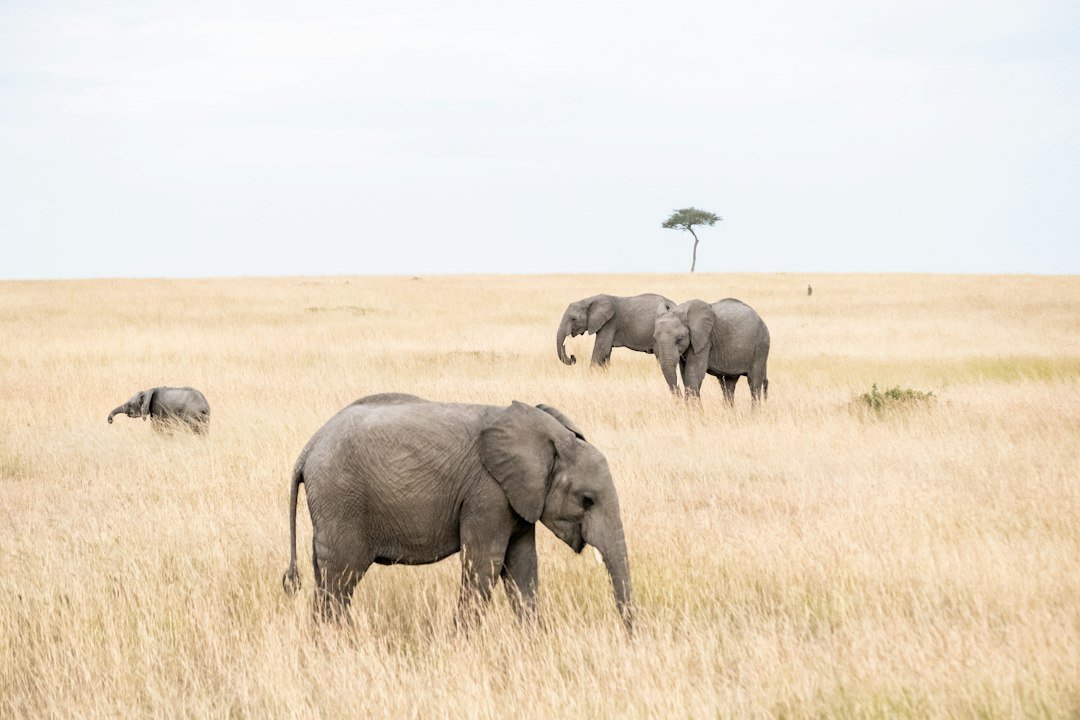
Savanna elephants are larger on average and include the largest living land animals.
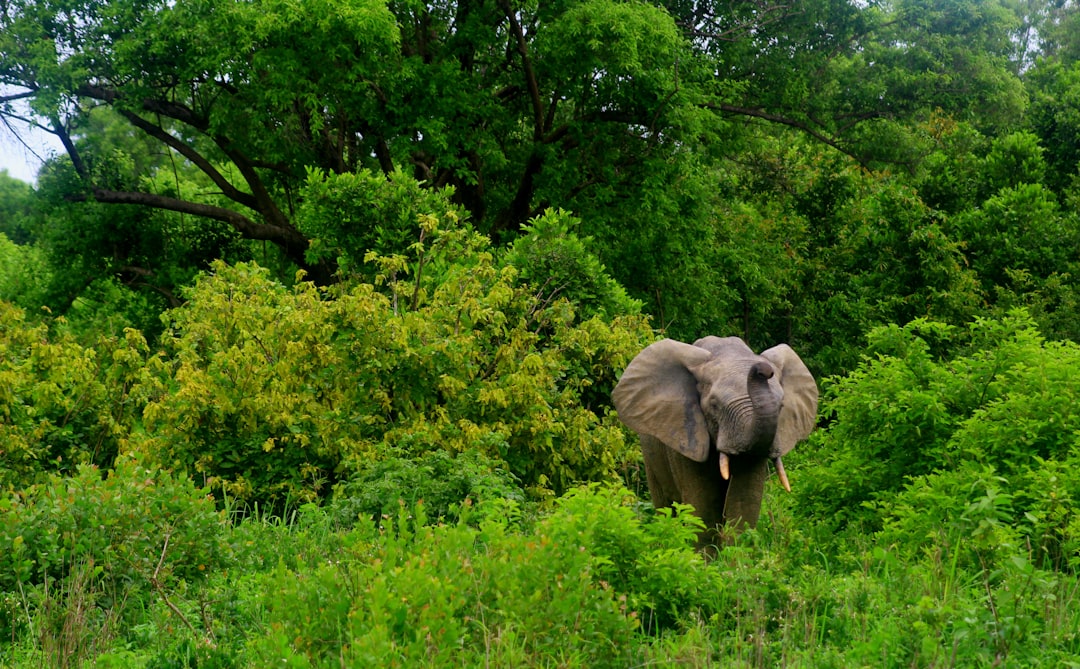
Forest elephants are smaller and more compact, an advantage in dense rainforest where manoeuvrability matters.
Ear shape
Savanna elephants generally have very large ears adapted in part to heat dissipation.
Forest elephants tend to have somewhat rounder, more compact ears.
Ear shape is useful in broad comparison but should not be treated as a perfect field diagnostic on its own.
Tusks
Forest-elephant tusks are often straighter and point more downward.
This shape may be useful for moving through dense vegetation.
Savanna-elephant tusks often curve outward more strongly.
Feet and movement
Forest elephants are adapted to moving through wet, dense terrain.
Their tracks, body proportions and movement style reflect a habitat where visibility is low and paths may be narrow.
Savanna elephants often operate across much more open country.
Habitat
The habitat difference is more profound than the species names imply.
Savanna elephants occupy open grasslands, shrublands, woodlands and semi-arid systems across sub-Saharan Africa.
Forest elephants are centred in the rainforests of West and Central Africa, especially the Congo Basin.
Visibility changes how we understand them
Savanna elephants are comparatively easy to observe.
Researchers can identify individuals, follow family groups and conduct aerial surveys.
Forest elephants may be physically close while remaining completely invisible under dense canopy.
How scientists study them
Habitat changes research methods dramatically.
Savanna elephants can often be monitored through direct observation, aerial counts and GPS tracking.
Forest-elephant research relies much more heavily on dung surveys, DNA, camera traps, acoustic monitoring and forest clearings.
Counting forest elephants is harder
Aerial surveys that work in open savanna are largely useless beneath closed rainforest canopy.
Historically, researchers estimated forest-elephant abundance from dung density and decay rates.
Genetic capture-recapture is now providing more robust estimates in some landscapes.
Social life
Both species are socially complex, but the way we observe that complexity differs.
Savanna-elephant family structures have been documented in extraordinary detail because researchers can follow known individuals over decades.
Forest-elephant social organisation is harder to study directly because groups disappear into vegetation.
Group size
Forest elephants are often seen in smaller groups than savanna elephants.
That does not necessarily mean their social networks are simpler.
Dense habitat and dispersed food can make large visible aggregations less common.
Forest clearings
Natural clearings known as bais are especially valuable because they allow forest elephants to be observed directly.
At these sites, researchers can study social interaction, mineral use and group composition in ways that are difficult elsewhere.
Diet
Savanna elephants may shift between grasses, browse, bark and fruit depending on season.
Forest elephants rely heavily on browse and fruit and are major dispersers of large seeds.
This difference gives forest elephants a particularly important role in rainforest regeneration.
Forest elephants as seed dispersers
Elephants consume fruit and move seeds long distances before depositing them in dung.
Some large-seeded tree species benefit strongly from this dispersal.
The loss of forest elephants can therefore change forest composition over time.
Landscape engineering
Both species influence vegetation structure.
Savanna elephants break branches, strip bark, open woodland and interact with fire and grass dynamics.
Forest elephants create trails, move seeds and affect tree recruitment.
Carbon and forest structure
Recent research has suggested that forest elephants may influence forest carbon storage by changing tree communities and vegetation structure.
The exact magnitude is still being studied, but the ecological effect extends beyond seed dispersal alone.
Movement
Savanna elephants may travel enormous distances between water, feeding areas and seasonal ranges.
Forest elephants also move widely, but their routes are harder to observe directly.
Forest roads, logging access and human activity can strongly influence where they travel.
Water
In dry savanna systems, water can organise elephant movement across entire landscapes.
Forest elephants generally operate in wetter environments, so food, minerals and disturbance may play relatively larger roles in movement.
Poaching
Both species have been heavily targeted for ivory.
Forest elephants suffered especially severe declines in parts of Central Africa during recent decades.
Dense habitat can make illegal killing difficult to detect quickly.
Why forest-elephant recovery is slow
Forest elephants reproduce slowly and live at relatively low density across huge areas.
Heavy poaching can therefore take decades to recover from even after killing pressure declines.
Conservation status
The African forest elephant is listed as Critically Endangered on the IUCN Red List.
The African savanna elephant is listed as Endangered.
Those categories reflect species-level risk, not the condition of every local population.
Local populations can differ dramatically
Some savanna-elephant populations are large and growing while others remain under severe pressure.
Likewise, some forest landscapes retain important strongholds while others have experienced heavy losses.
Conservation status therefore needs both species-level and landscape-level interpretation.
Hybrid zones
Forest and savanna elephants can meet and interbreed in some regions.
Genetic studies have documented zones of admixture where the ranges approach one another.
This does not erase the deep evolutionary distinction between the species.
Why conservation methods cannot simply be copied
A forest-elephant conservation programme cannot simply copy methods developed for Amboseli or the Serengeti.
Dense forest changes how elephants are counted, how poaching is detected, how movements are monitored and how habitat is protected.
Tourism differs too
Savanna elephants can often be watched from vehicles in open terrain.
Forest-elephant viewing is usually less predictable and may depend on clearings, hides or long periods of waiting.
The two experiences should not be judged by the same expectations.
Which species has bigger tusks?
There is no simple rule that one species always has “bigger tusks.”
Tusk size varies by sex, age, population and selective pressure.
Forest-elephant ivory is often denser and straighter, but historical trade has distorted natural tusk-size distributions in both species.
Why the distinction matters scientifically
If forest and savanna elephants are lumped together, population trends can be misleading.
A large savanna population cannot compensate biologically for the loss of a distinct forest-elephant lineage.
Species recognition therefore changes how decline and recovery are measured.
Why the distinction matters legally and politically
Conservation planning, funding and trade policy can all be affected by whether species are treated separately.
Scientific classification therefore has practical consequences.
What they share
Both species are highly social, long-lived, intelligent and ecologically influential.
Both require large landscapes and both face threats from poaching, fragmentation and human pressure.
The similarities are real, but they should not obscure the ecological and evolutionary differences.
Why species recognition changed conservation priorities
When forest and savanna elephants were treated as one species, severe forest-elephant declines could be partly obscured by healthier savanna populations elsewhere.
Recognising two species forces conservation assessments to evaluate each evolutionary lineage on its own terms.
Why morphology alone is not enough
Body size, ears and tusks are useful field clues, but individuals vary and some populations occur near zones of admixture.
Genetics provides a much stronger basis for species distinction than appearance alone.
Why the two species respond differently to disturbance
Open-country elephants can sometimes shift visibly around roads or settlements. Forest elephants may alter movement in ways that are much harder to detect under dense canopy.
This means conservation pressure can build in forest landscapes long before it becomes obvious to observers.
Why the two species need different survey strategies
Open savanna allows direct counting and individual observation at a scale that rainforest does not.
Forest-elephant monitoring therefore relies far more heavily on genetics, acoustics and indirect signs. Using the same survey design for both species can produce misleading comparisons.
Why recovery rates differ
Forest elephants tend to occur at lower densities and their populations have been heavily reduced in parts of Central Africa.
Even under improved protection, rebuilding those populations can take a very long time because reproduction is slow and surviving groups may be widely separated.
Why ecological roles differ as well
Savanna elephants strongly influence woodland structure, grass availability and water-centred landscapes.
Forest elephants are especially important as long-distance seed dispersers and can influence rainforest tree communities. Losing either species changes ecosystems in different ways.
Why conservation status should not be confused with local abundance
A species can be globally threatened while remaining common in one stronghold, or globally less threatened while declining sharply in a particular landscape.
This is why local monitoring and species-level Red List status answer different questions.
Why forest-elephant ecology is easier to underestimate
Dense habitat hides both the animals and many of their ecological effects.
Seed dispersal, trail creation and long-distance movement can therefore remain invisible to observers who judge ecological importance mainly from direct sightings.
Why savanna and forest conservation need different expectations
Savanna systems often allow rapid visual feedback: researchers can see group size, body condition and calf presence directly.
Forest conservation may require slower inference from genetics, acoustics and dung, which means management decisions often have to work with greater uncertainty.
Why species-specific conservation messages matter
Public communication often still uses “African elephant” as if it described one ecological problem.
Separating forest and savanna elephants helps explain why a strong population in one habitat does not cancel severe decline in the other, and why survey, tourism and protection methods need to differ.
Related reading
African Forest Elephants →
Counting Elephants — scheduled for 22 January 2027.
Elephants in the Democratic Republic of the Congo — scheduled for 16 March 2027.
Elephant Dung DNA — scheduled for 11 December 2026.
Sources
IUCN — African Forest Elephant
IUCN — African Savanna Elephant