African forest elephants are a distinct species adapted to the dense rainforests of West and Central Africa. They are smaller and more compact than African savanna elephants, live in far less visible habitats and play an outsized ecological role as seed dispersers and forest engineers.
They are also among the most threatened large mammals in Africa.
A separate species
The African forest elephant is Loxodonta cyclotis.
Genetic research has shown deep evolutionary separation from the African savanna elephant, Loxodonta africana.
That distinction matters because forest and savanna elephant populations face different threats, require different survey methods and cannot simply be combined into one conservation total.
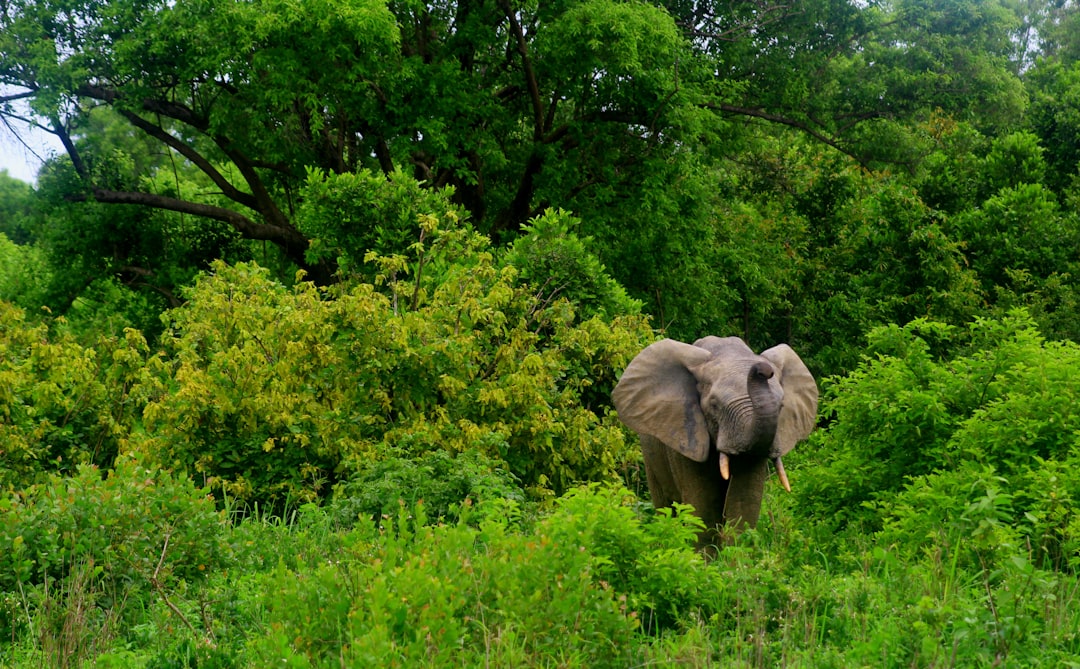
How forest elephants differ physically
Forest elephants are generally smaller and more compact than savanna elephants.
Their ears tend to be rounder and their tusks straighter and more downward-pointing.
Those traits are useful field clues, but appearance alone should not be treated as a perfect species test.
Why smaller size makes sense
Dense rainforest rewards manoeuvrability.
A more compact body can move through narrow vegetation more easily than the very large body typical of open-country savanna elephants.
Tusks
Forest-elephant tusks are often relatively straight and dense.
Historically, these characteristics made forest-elephant ivory highly valued in illegal trade.
That contributed to intense poaching pressure across parts of Central Africa.
Habitat
Forest elephants occur primarily in the Congo Basin and remaining rainforest systems of West and Central Africa.
Their range includes dense lowland forest, swamp forest, river systems and natural clearings.
Why visibility is so poor
Under closed canopy, visibility may be only a few metres.
An elephant can be nearby without ever being seen.
This changes everything about how scientists monitor the species.
Forest clearings and bais
Natural forest clearings, often called bais, can attract elephants to water or mineral-rich soil.
These sites provide rare opportunities for direct observation.
Researchers can identify individuals, study social interaction and record behaviour that would be almost impossible to see inside closed forest.
Diet
Forest elephants eat browse, leaves, bark and especially fruit.
Fruit consumption makes them major long-distance seed dispersers.
Seed dispersal
Elephants can swallow large fruits whole and carry the seeds over long distances.
Those seeds may later be deposited in dung far from the parent tree.
This helps maintain forest regeneration and genetic mixing among plant populations.
Why large seeds matter
Some rainforest trees produce fruits too large for many smaller animals to transport effectively.
Forest elephants can move these seeds across kilometres.
That makes their ecological role difficult to replace.
Forest structure
Elephants also browse, break vegetation, create trails and alter tree recruitment.
Research has suggested that these effects can influence forest structure and potentially carbon storage.
Why carbon is part of the conversation
If elephants alter the relative abundance of tree species with different wood densities or growth forms, they may indirectly influence how much carbon the forest stores.
The exact scale remains an active research question.
Movement
Forest elephants can travel long distances through rainforest, but their routes are difficult to observe directly.
They may move between fruiting areas, clearings, mineral sites and water while remaining almost invisible to researchers.
Roads and access
Logging and mining roads can change elephant landscapes quickly.
They may open access to previously remote forests and increase hunting risk.
Roads can also alter movement directly through disturbance and settlement.
Logging landscapes
Selective logging does not always remove all elephant habitat, but roads and human access can be more damaging than tree removal alone.
The conservation effect depends heavily on governance and hunting control.
Mining
Mining can create roads, camps, settlement and habitat fragmentation.
Even when the mine footprint itself is small, the associated infrastructure can affect a much wider area.
Why counting forest elephants is difficult
Aerial surveys that work in open savanna are largely useless beneath rainforest canopy.
Researchers therefore rely on dung counts, genetics, camera traps, acoustics and local field knowledge.
Dung surveys
Traditional surveys estimate elephant density from the number of dung piles found along transects.
Researchers then use assumptions about defecation and dung decay to convert dung density into elephant abundance.
Why dung decay creates uncertainty
Rain, insects, temperature and forest conditions affect how long dung remains visible.
Incorrect decay assumptions can distort abundance estimates.
Genetic capture-recapture
DNA from dung can identify individual elephants.
If the same individuals are detected repeatedly, capture-recapture models can estimate the number of unseen elephants in the wider population.
This reduces dependence on dung-decay assumptions.
Why DNA has changed forest-elephant estimates
Improved genetic methods and broader survey coverage have produced more robust population estimates in recent years.
A higher modern estimate does not automatically mean the population suddenly recovered; it may reflect better detection.
Camera traps
Cameras can document elephants using trails, clearings and other predictable locations.
Where tusks, ears or scars are distinctive, individuals may sometimes be recognised.
Acoustic monitoring
Forest elephants use low-frequency calls that can travel through dense vegetation.
Passive recorders can detect activity at times and places where human observers are absent.
Why acoustic data are useful
Sound can reveal presence and activity even when no elephant is visible.
It can also help monitor remote areas over long periods.
Social life
Forest elephants are socially complex, but their group structure is less directly observable than that of savanna elephants.
Smaller visible groups do not necessarily mean simpler social networks.
Why group size may be smaller
Dense forest and dispersed fruit can favour smaller travelling units.
Related elephants may remain socially connected even when not visible together.
Poaching
Forest elephants suffered severe ivory poaching across much of their range during recent decades.
The species is listed as Critically Endangered on the IUCN Red List.
Why poaching is hard to detect
Carcasses can remain hidden in dense vegetation and decompose before patrol teams discover them.
Remote landscapes also make regular patrol coverage difficult.
Why recovery is slow
Forest elephants reproduce slowly and occur at relatively low density.
Heavy adult mortality can therefore take decades to recover from even after poaching declines.
Age structure matters
Selective killing can remove older animals with decades of experience.
Population growth does not instantly restore those age classes.
Ivory forensics
Forest-elephant conservation is closely linked to DNA forensics.
Reference samples from dung can help estimate where seized ivory originated.
This is particularly important in remote source landscapes where direct enforcement intelligence may be limited.

The DRC
The Democratic Republic of the Congo contains some of the most important remaining forest-elephant habitat.
It also presents major challenges: huge distances, difficult access, armed conflict and extractive pressure.
Lomami and TL2
The original Elephant Ivory Project’s 2011 expedition worked in the TL2/Lomami region of central DRC.
The goal was to collect usable elephant dung from a poorly represented part of the genetic reference map.
Why local field teams matter
Finding fresh dung in rainforest depends heavily on trackers and researchers who know recent elephant movement.
Remote field science is collaborative by necessity.
Protected areas
National parks are critical but do not cover every forest used by elephants.
Logging concessions, community land and remote road systems can all influence survival and movement.
Landscape conservation
Forest-elephant protection therefore requires secure habitat, controlled access, anti-poaching intelligence and long-term monitoring across wider landscapes.
Why forest elephants matter beyond the species itself
Their disappearance would alter rainforest ecology.
Seed dispersal, trail formation and tree-community effects would all change.
Forest-elephant conservation is therefore also forest conservation.
Why species recognition matters
Savanna-elephant abundance cannot compensate biologically for forest-elephant decline.
They are distinct evolutionary lineages with different ecological roles.
Tourism
Forest-elephant viewing is usually more difficult and less predictable than savanna viewing.
At bais and clearings, however, visitors may witness behaviour that is almost impossible to observe elsewhere.
Why lower sighting frequency is not lower value
Rainforest elephant experiences require patience.
The reward is access to a species and ecosystem operating on very different terms from open-country safari systems.
What scientists still need to learn
Many forest-elephant populations remain poorly monitored.
Questions about social structure, movement, recovery and climate response are still difficult to answer at scale.
The conservation priority
Protecting remaining strongholds before access, fragmentation and illegal killing intensify is usually easier than rebuilding populations after collapse.
For a slow-reproducing species, prevention has enormous value.
Why forest-elephant conservation needs patient monitoring
Low-density populations in dense habitat will not show recovery quickly.
Managers may first see improved signs such as lower illegal mortality, more consistent detections and stronger connectivity before a clear numerical increase becomes measurable.
Why forest access has to be managed carefully
New roads can improve logistics for communities and conservation teams while simultaneously increasing hunting and settlement pressure.
The challenge is not simply whether access exists, but who controls it and how it changes the risk landscape.
Why local strongholds matter disproportionately
Where forest elephants remain relatively secure, preventing decline is far easier than rebuilding a population after collapse.
Protecting those strongholds should therefore remain a high conservation priority.
Why forest-elephant recovery needs connected strongholds
Protecting isolated pockets is not enough if animals cannot move or breed between them.
Connectivity helps maintain gene flow and gives populations more resilience when local conditions deteriorate.
Why monitoring effort should target gaps as well as strongholds
Well-known sites naturally attract more research, but poorly surveyed forests may contain important populations that remain underestimated.
Strategic sampling should therefore expand beyond the places where elephants are easiest to study.
Why forest-elephant monitoring should remain adaptive
As genetics, acoustics and remote sensing improve, researchers can refine how populations are measured without abandoning the long-term value of older data.
The goal is better detection with enough methodological continuity to preserve meaningful trends.
Explore forest elephants
Elephants in the Democratic Republic of the Congo → — scheduled for 16 March 2027
Lomami, TL2 and the Elephant Ivory Project → — scheduled for 19 March 2027
Forest Elephant vs Savanna Elephant → — scheduled for 6 November 2026
Elephant Dung DNA → — scheduled for 11 December 2026
Counting Elephants → — scheduled for 22 January 2027
Sources
IUCN — African Forest Elephant
IUCN — DNA methods and forest-elephant population estimates