Elephant intelligence is real, impressive and frequently exaggerated. The strongest science does not show a mystical animal with human-like reasoning. It shows a large-brained, long-lived social mammal with sophisticated abilities shaped by elephant problems: remembering individuals and places, coordinating with others, solving practical tasks and navigating a changing landscape.
The useful question is not “How smart are elephants?” as if intelligence were one score. It is which cognitive abilities elephants possess, how those abilities are tested and what they are used for in the wild.
Why elephant intelligence is difficult to measure
Most intelligence tests are designed by humans and often privilege human sensory strengths.
Elephants rely heavily on smell, low-frequency sound, touch and social memory. A task based on visual manipulation may underestimate abilities that matter much more in elephant life.
This is why cognition studies need to be interpreted in ecological context.
A very large brain
Elephants have the largest brains of any living land animal.
Brain size alone does not prove intelligence, but elephant brains contain extensive neural development associated with sensory integration, memory, motor control and social behaviour.
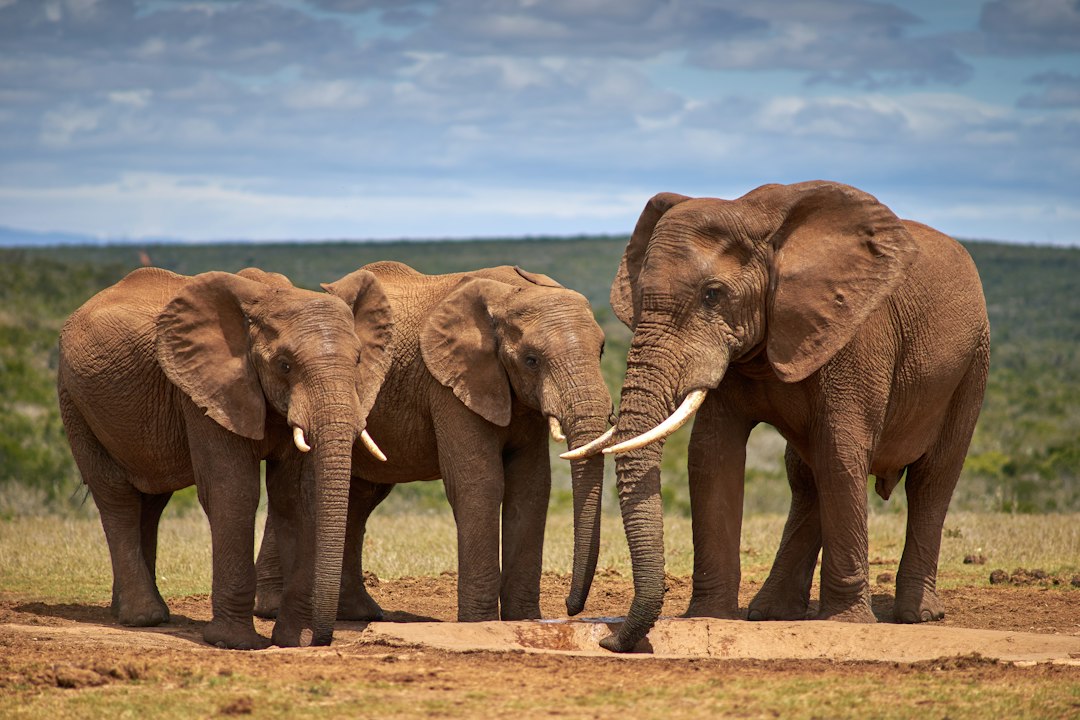
Memory
Elephants show strong long-term memory in several domains.
They can recognise individuals, remember locations and retain information about social relationships over long periods.
Long-lived animals benefit from remembering rare events such as severe drought or unusual threats.

Social recognition
Elephants live in complex social networks.
Females may interact with relatives, neighbouring families and unfamiliar groups over decades. Bulls also form age-structured associations.
Recognising who is familiar, dominant, related or reproductively relevant is therefore cognitively valuable.
Matriarch experience
Research in Amboseli has shown that older matriarchs can influence family responses to social and threat cues.
This suggests that experience accumulated over decades can become a group resource.
The cognitive value lies not only in individual memory but in how that memory affects collective decisions.
Problem-solving
Elephants can solve practical tasks involving access to food, barriers and manipulation.
Some controlled studies have tested whether elephants can understand means-end relationships or use objects to solve problems.
The results are interesting, but no single puzzle should be treated as a complete measure of intelligence.
Tool use
Elephants use objects in flexible ways.
They may manipulate branches for fly control, move objects to reach food or modify materials during exploration.
Tool use is one useful cognitive indicator, but it is not a requirement for intelligence.
Cooperation
Controlled experiments have shown that elephants can coordinate actions with another elephant when success requires both individuals to participate.
This suggests sensitivity to the role of a partner rather than simple simultaneous action.
Why cooperation matters in the wild
Family life already requires coordination.
Elephants move together, defend calves, respond to threats and negotiate access to resources.
Experimental cooperation therefore fits naturally into the social demands of elephant life.
Mirror self-recognition
Asian elephants have shown evidence of mirror self-recognition in controlled experiments.
In one widely cited study, an elephant used a mirror in a way interpreted as recognition of its own body.
This result is notable, but mirror tests should not be treated as a universal benchmark of self-awareness.
Body awareness
Other experiments have tested whether elephants understand when their own body is physically preventing them from completing a task.
Such studies suggest elephants can represent their bodies as obstacles under certain conditions.
Again, this measures one specific cognitive ability rather than intelligence as a whole.
Inhibitory control
Recent elephant cognition research has examined whether elephants can suppress an immediate response in order to solve a problem.
Detour tasks, for example, test whether an animal can resist moving directly toward visible food when the successful route requires going around a barrier.
Performance varies between individuals.
Why self-control is not a ranking
An elephant performing poorly on one inhibition task is not “less intelligent” in a general sense.
Cognition is modular and context-dependent.
Different tasks may favour different sensory strategies, experience or motivation.
Communication and cognition
Elephant communication requires recognition, memory and context.
Animals respond differently to familiar and unfamiliar calls, assess threat-related sounds and use vocal, chemical and gestural information together.
This integration is one of the strongest windows into elephant cognition.
Human voice discrimination
Studies have shown that elephants can distinguish between different human voices and respond according to learned risk.
That ability is especially relevant in landscapes where elephants have long histories of interaction with people.
It demonstrates flexible learning rather than “understanding language.”
Gesture and intentionality
Recent research has examined whether elephants use gestures in ways consistent with communicative intent.
Repeated signals, recipient-directed behaviour and changes after failed communication can suggest that elephants are trying to influence another individual’s behaviour.
This strengthens the picture of elephant communication as flexible and goal-directed.
Do elephants understand death?
Elephants show unusual interest in dead elephants, bones and distressed companions.
They may inspect remains repeatedly or alter behaviour around a dead individual.
These observations are consistent with complex social responses to death, but scientists are cautious about claiming a human-like concept of mortality.
Emotion and intelligence are not the same thing
Descriptions of elephants as compassionate, grieving or empathetic are common.
Some behaviours are certainly compatible with complex emotional states, but emotional interpretation and cognitive testing are different scientific questions.
Anthropomorphic language can be useful descriptively but should not replace evidence.
Learning from older elephants
Calves and younger elephants spend years in social groups containing experienced adults.
They learn routes, feeding choices, social relationships and responses to danger.
This social learning is one reason the loss of older animals can have consequences beyond simple mortality.
Male social learning
Young bulls also appear to benefit from association with older males.
Research from populations where mature bulls were absent has suggested that abnormal behaviour can emerge when young males grow up without a normal older-male social structure.
Spatial cognition
Elephants can use very large landscapes.
Remembering water, seasonal forage, corridors and danger areas requires a sophisticated spatial memory.
GPS tracks often reveal repeated route use that suggests strong knowledge of landscape structure.
Smell and cognition
Human cognition research often emphasises vision, but elephants rely heavily on olfaction.
They can use smell to assess identity, reproductive condition, food and social information.
Tests that ignore olfaction therefore miss an important part of how elephants process the world.
Why captivity can distort cognition studies
Controlled experiments are easier with elephants accustomed to humans.
That gives researchers experimental precision but creates limits on generalisation.
A captive elephant may have extensive experience with objects, commands and human cues that a wild elephant does not.
Wild studies are difficult for the opposite reason
Wild elephants behave naturally but cannot be controlled experimentally in the same way.
Researchers therefore combine observation, playback experiments, GPS movement and opportunistic natural experiments.
The strongest conclusions often come from both settings together.
Why intelligence evolved
Elephants face cognitively demanding lives.
They are long-lived, social, mobile and ecologically flexible. They must remember landscapes, negotiate social relationships and adapt to changing resource conditions.
Those demands provide a plausible evolutionary context for sophisticated cognition.
What elephant intelligence does not mean
It does not mean elephants think like humans.
It does not mean every elephant solves every problem equally well.
And it does not mean one dramatic anecdote proves a broad cognitive ability.
The better question
Instead of asking whether elephants are “as intelligent as” another species, ask what problems elephant cognition is adapted to solve.
That approach produces better science and a more accurate understanding of the animal.
Why elephant cognition should be studied comparatively but not ranked
Comparing species can reveal how different ecological pressures shape problem-solving, memory and social cognition.
But turning those comparisons into a league table of intelligence is usually misleading because species rely on different senses, motivations and forms of learning.
Why ecological validity matters
A task that makes sense to a human experimenter may be unnatural to an elephant.
The strongest cognition studies therefore ask whether the experimental problem resembles something the animal might actually need to solve in the wild.
What long-term field studies add to cognition research
Controlled experiments isolate specific abilities. Long-term field studies show whether those abilities matter across years of real social and ecological decisions.
Used together, the two approaches provide a much stronger picture than either can alone.
Why elephant intelligence is best understood in context
An elephant does not need to solve the same problems as a crow, dolphin or primate. Its cognition evolved around long-distance movement, social recognition, olfactory information and a lifespan measured in decades.
Those demands shape which abilities are most useful.
Why individual differences matter
Not every elephant performs the same way in cognitive tasks.
Age, experience, motivation and prior exposure to humans or objects can all influence performance, which is another reason one experiment should not be turned into a species-wide verdict.
What future cognition research needs
The strongest next steps will combine controlled experiments with long-term field histories and natural behaviour.
That approach can show not only whether elephants can solve a task, but whether the same ability matters in the wild.
Why elephant cognition should be tested across several sensory systems
Many classic animal-cognition experiments are visually biased because they were designed for humans and primates.
Elephants rely heavily on smell, low-frequency sound and touch, so a fuller picture of cognition requires tasks that reflect those sensory strengths.
Why social cognition may be especially important
Elephants spend decades managing relationships, recognising individuals and responding to the behaviour of others.
Those demands may be more central to elephant intelligence than solving an unfamiliar puzzle box in a test enclosure.
Why anecdotes still need experimental follow-up
Wild elephants often do things that look ingenious, but one striking observation cannot establish a general cognitive ability.
The strongest science begins with those observations and then tests whether the same pattern can be reproduced or explained systematically.
Related reading
Elephant Memory — scheduled for 3 November 2026.
Elephant Communication →
Elephant Self-Control Research — research note follows later in the series.
Elephant Family Groups — scheduled for 5 January 2027.
Sources
Plotnik et al. — Mirror self-recognition in an Asian elephant
Plotnik et al. — Elephant cooperation
PLOS ONE — Elephant inhibitory control