Elephant memory is one of the species’ most famous traits — and one of the easiest to mythologise. “An elephant never forgets” is not literally true. What the science does show is more interesting: elephants can retain social, spatial and olfactory information over long periods, and that memory can influence the survival of entire family groups.
Memory is not one ability
When people talk about memory, they often mean one thing. In reality, elephants use several forms of memory:
- social recognition
- spatial memory
- olfactory memory
- long-term recognition of individuals
- memory of routes, water and seasonal resources
These abilities matter because elephants are long-lived, wide-ranging and highly social.
Long-term social memory
Elephants can recognise individuals they have not encountered for long periods.
In wild populations, this ability matters because family groups split and reunite, neighbouring groups may meet irregularly and some bulls disappear for months or years before returning.
Remembering who is familiar and how that individual behaved previously is socially useful.
Matriarchs and social knowledge
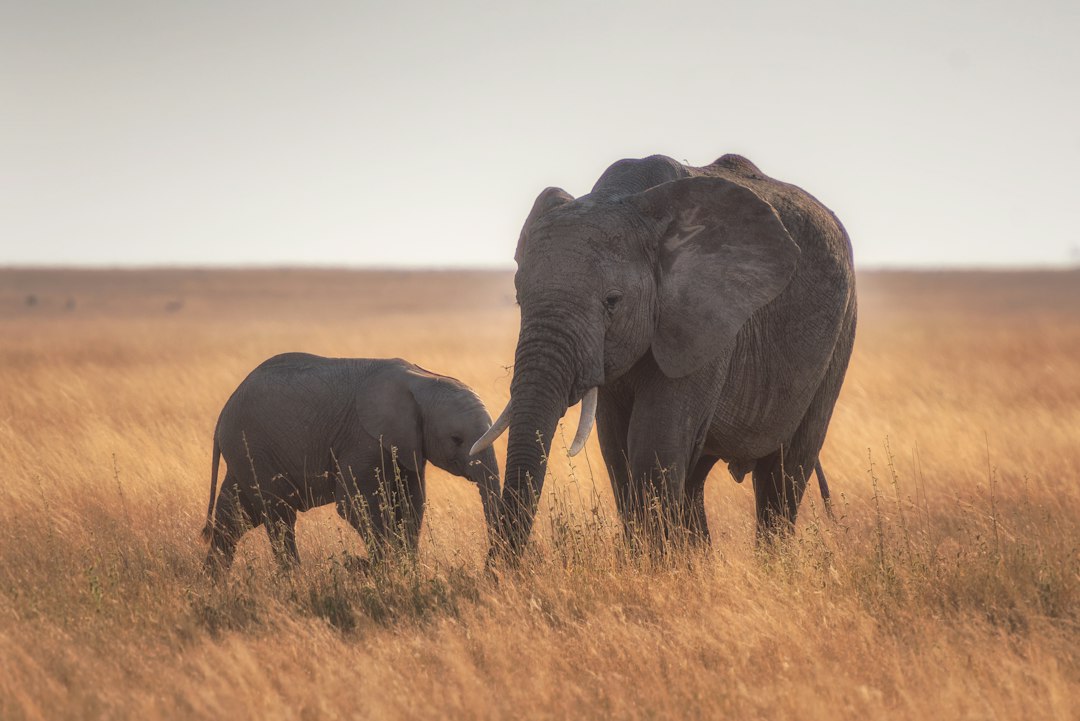
Older females often have more extensive social experience than younger ones.
Amboseli research has shown that families led by older matriarchs can respond more appropriately to unfamiliar social cues.
The likely explanation is not mystical wisdom but accumulated memory of more individuals and situations.
Memory of drought
In dry landscapes, knowledge of water can become a survival advantage.
Older elephants may have experienced droughts decades earlier and remember distant water sources or alternative routes.
This is difficult to test directly, but long-term field observations strongly suggest that experience influences movement during extreme conditions.
Spatial memory
Elephants can use very large home ranges.
They revisit waterholes, feeding areas, river crossings and seasonal routes over long periods.
Repeated movement suggests a detailed internal representation of landscape structure rather than simple wandering.
How GPS tracking reveals memory indirectly
GPS collars do not measure memory itself.
But repeated return to particular routes, crossings and resources can reveal highly structured movement.
When the same individual returns to a distant location under similar seasonal conditions, memory is one plausible component of that behaviour.
Olfactory memory
Smell is central to elephant life.
Elephants can use scent to recognise individuals, reproductive condition and food.
Research has shown retention of olfactory information over extended periods, reinforcing the idea that elephant memory should not be thought of mainly in visual terms.
Faecal odour and kin recognition
Experimental work has shown that elephants can extract social information from dung and other scent sources.
That makes sense in the wild, where olfactory traces remain after the animal itself has moved away.
Former keepers and long-term recognition
There have been striking reports of elephants recognising former human caretakers after long separations.
Such cases are interesting but should be treated carefully because sample sizes are small and circumstances vary.
They support the broader picture of durable recognition without proving limitless memory.
Visual memory
Elephants can also remember visual discriminations and learned tasks.
Older experimental work demonstrated retention of visual information over long intervals.
Again, the important point is not that elephants are uniquely perfect rememberers, but that long-term retention fits their ecology.
Why memory matters in family life
A family group depends on shared knowledge of routes, social partners and danger.
Calves do not begin life with decades of landscape experience. They learn by following older elephants.
Memory therefore becomes intergenerational through social learning.
What happens when experienced elephants are lost?
Poaching or other mortality can remove older animals carrying decades of knowledge.
The population may still contain many elephants, but younger survivors may lose access to information that was never written down anywhere except in the behaviour of experienced adults.
Memory and human threats
Elephants can learn where human activity is dangerous.
They may avoid certain roads, settlements or times of day based on previous experience.
In some landscapes, elephants become more nocturnal in response to human pressure.
Can elephants remember individual humans?
There is evidence that elephants can distinguish human voices and categories associated with different levels of risk.
Captive elephants can also learn individual keepers.
Whether a wild elephant remembers one specific person years later is harder to test rigorously, but the broader ability to retain human-related cues is well supported.
Memory and communication
Recognising a call requires memory.
Elephants respond differently to familiar and unfamiliar vocalisations, which implies stored information about social partners.
Communication and memory are therefore deeply linked.
Memory and smell
Humans tend to imagine memory visually because vision dominates our own experience.
Elephants live in a much more olfactory world.
A scent trail, dung pile or urine sample may carry information long after visual contact has ended.
Do elephants remember the dead?
Elephants show unusual interest in the remains of dead conspecifics.
They may investigate bones, tusks or carcasses repeatedly.
These behaviours suggest strong social memory, although researchers are cautious about attributing a human-like concept of mourning.
Why memory is adaptive
Elephants benefit from memory because their environment is variable.
Water may disappear, food shifts seasonally, social groups change and danger is unevenly distributed.
A long-lived animal that remembers rare but important events can make better decisions later.
Why older animals matter
Age is not automatically wisdom, but experience creates opportunity to learn.
An older elephant has encountered more droughts, more families, more predators, more human threats and more reproductive situations.
That makes age structure itself a conservation consideration.
Can memory be measured directly?
Some laboratory-style tasks can test retention over time.
But many of the most ecologically important memories — such as the location of a drought refuge — are difficult to reproduce experimentally.
Researchers therefore combine controlled studies with long-term field observation.
What memory is not
Elephants do forget.
They can make mistakes. Individuals differ. Memory can decay.
The scientific picture is powerful precisely because it does not require the myth of perfect recall.
Why memory matters for conservation
If conservation protects only numbers and ignores age structure, it can miss an important part of population function.
Keeping experienced adults alive can preserve social and ecological knowledge that younger elephants use.
This is one reason selective killing of old females and bulls can have effects beyond mortality itself.
Memory is shaped by experience, not just age
Two elephants of the same age may not know the same things. Experience depends on which droughts, migrations, social encounters and human threats an individual has actually lived through.
This is why age is best understood as an opportunity to accumulate knowledge rather than a guarantee of superior memory.
Memory can be context-specific
An elephant may retain social information very well while performing less impressively on an artificial visual task.
That is not a contradiction. Different memory systems solve different problems, and the most ecologically important ones may be difficult to reproduce in controlled experiments.
What researchers still do not know
Scientists still have limited ability to measure how elephants mentally represent very large landscapes or how memories are shared within families.
Long-term tracking, playback experiments and individual histories are gradually filling those gaps, but many popular claims still extend beyond the evidence.
How memory can shape group decisions
An individual memory becomes socially important when other elephants follow the animal holding that information. A matriarch remembering water or recognising a risky social cue can therefore influence the behaviour of an entire family.
Why rare events are especially important
Some ecological events happen only a few times in an elephant’s life. Severe drought, unusual flooding or a major disturbance may be separated by decades.
A long-lived animal can retain experience that younger members of the group have never had the opportunity to acquire.
Memory and conservation translocation
Moving elephants into unfamiliar landscapes removes the benefit of local spatial memory. Translocated animals must learn new water, boundaries and danger points from scratch.
This is one reason movement and settlement after translocation can be unpredictable, even when the destination appears suitable on a habitat map.
Why elephant memory research needs long timescales
Many ecologically important memories are only tested by events that occur years apart.
A drought refuge, a distant migration route or the identity of a neighbouring family may matter only occasionally, which makes short experiments an incomplete window into memory.
Why forgetting matters too
Memory is adaptive partly because information can be updated. An elephant may stop using an old route if a fence appears or if a water source disappears.
Flexible memory is therefore as important as long retention.
How social memory and spatial memory interact
An elephant may remember not only where a resource lies but which other elephants usually occupy that area.
In a social species, place and relationship are often linked, which is one reason memory has to be studied across several domains at once.
Why memory research benefits from individual life histories
If researchers know an elephant’s age, family and past experience, they can interpret a response in context.
The same test result may mean something different for a young elephant with little prior exposure than for an old matriarch that has encountered the stimulus for decades.
Why memory can influence risk assessment
Elephants can learn which places, sounds or human activities are dangerous.
That learned caution may reduce immediate risk but can also push movement into other parts of the landscape.
Why conservation can erase or preserve memory
When old elephants survive, their accumulated knowledge remains available to younger animals.
When they are selectively removed, the population may lose information that cannot be restored quickly through births alone.
Why memory can influence migration and range fidelity
Repeated return to the same seasonal areas suggests that elephants remember not only individual resources but the broader structure of a landscape.
That fidelity can be beneficial when habitats remain stable and risky when roads, fences or settlements suddenly alter an old route.
Why old routes can become dangerous
Memory is useful only if the world remains recognisable.
An elephant following a familiar path may encounter new infrastructure that did not exist when the route was learned.
Why memory research belongs in conservation planning
Management decisions that block traditional routes can collide with decades of learned behaviour.
Understanding that history can help explain why elephants persist in trying to cross places that now look unsuitable to people.
Related reading
Elephant Intelligence →
Elephant Communication →
Elephant Family Groups — scheduled for 5 January 2027.
How Poaching Changes Elephant Societies — scheduled for 26 February 2027.